Sunday, 4 January 2015

Rough Cut - Miss Georgiou

Rough Cut

To any production, audience feedback is important. This is because it allows any strengths and weaknesses to be identified, allowing for acknowledgement as to what needs to be altered to improve the production. Having an audience's view and opinion of the production allows for the makers to improve on making the production more appealing to the target audience and therefore, creating a more successful product. Audience feedback not only outlines the faults in the production, but also the strengths. Knowing the difference between the two helps the makers in knowing what is good to keep in the production and what would need to be improved on. So generally, audience feedback helps the makers of a production know what to improve and allows them to think of the different ways in which they could improve the weaknesses especially from the constructive feedback.

We received audience feedback from our target audience from a screening of our production in class where the age range was our target audience. Having our target audience view our film and share their opinion with us allowed us to have a higher level of confidence in knowing the feedback in which we would get would be relevant, representative and valid. Furthermore, this feedback would ensure that we would be meeting the needs of our target audience once taking the comments on board and acting on them. Direct feedback from this specific age range gives us a great opportunity to act on what they particularly want to see in and from the sequence we have created. Moreover, it also makes sure that we are monitoring response in a way that we are able to witness reactions and feelings towards the sequence. For example, from just getting comments through a cyber experience, it restricts us seeing the reactions the audience may have to our sequence. From us being able to see the reactions, we are able to analyse where certain reactions occur, when certain reactions should occur and what reactions we want to occur. 


This feedback benefits not only our production, but also the film industry. Our production is benefitted from the direct reference to our specific sequence, feedback points out the particular parts of our sequence that stood out - whether that be in a good or bad way. This then allows us to improve our production and therefore we benefit as our sequence is then more successful and conventional to the thriller genre as well as being appropriate for our target audience. The film industry benefits because the feedback provides further research into how this target audience feels about a opening thriller sequence and what they would like for it to include. This helps the film industry, especially thriller films in the industry as they are able to use the research to reach the expectations of the feedback to ensure that the film is achieving the goals that are set for it to achieve - for example, staying conventional to the thriller genre and being appealing to the target audience. Other genres also benefit as the feedback from a thriller sequence shows what they expect from a thriller and so makes the makers of the other film genres to ensure that their genre consists of conventions that are not thriller ones. This benefits them as their criteria for their particular genre is heightened from the definite conventions that are included in that criteria that will not be the same as the conventions of a thriller. Overall, both benefit as it improves the knowledge and research into what the target audience expect from thrillers and what can be improved to make the film more impactive and appealing to the target audience.

Positive comments really help when receiving feedback as they outline the elements that stand out for being good and we managed to retrieve some from our viewing. One for example was 'the use of a dim filter makes the atmosphere more tense and also is conventional to the thriller genre'. As a group, we were happy with this comment as this is what we were intending to create for our sequence - a tense and eerie atmosphere that leaves the audience on the edge of their seat. Knowing that this has been created through the use of dimming the lighting down using a filter we have applied, is a satisfying element that we know not to change as it is doing it's allocated job. As well as the fact that from this comment, we know that we are sticking to the conventionality of the thriller genre, which is part of our aim. Another positive comment from our feedback was, 'I like the way that you have included different types of shots, it keeps it interesting'. We decided to include a variation of cinematography to make our scenes not appear repetitive and boring, so knowing that our audience finds our use of shots 'interesting' is a satisfying thought. Some shots took more effort than others for example, the high angle shot was filmed by holding the very end of the tripod at a height and on a tilt so that it could be filmed precisely and at the angle we wanted, so it is good to know that the audience have appreciated this effort. A further positive comment was 'The credits are good how they appear on screen over the shots and don't manage to restrict any view of the focus of the shot'. When creating our opening credits we tried to ensure that whereabouts we included them, they wouldn't block out any of importance in a scene. Luckily, at the beginning we planned our shots so that we could have space for names/credits for each shot we filmed. This therefore, made sure that credits wouldn't stop certain parts of a shot from being seen and so we are glad that our audience has noticed this. We will use these positive comments when editing our rough cut, as it allows us to keep the positive elements present in our sequence.

We also received some constructive comments which are really useful when we come to improve our rough cut as, constructive comments explain how we can improve certain parts that may need to be in order to make the sequence more successful to its needs. One of the constructive comments that we received was 'the sound was good but not consistent, so maybe to improve there could be an eerie soundtrack to play underneath to create more tension'. This comment was very fair as we had noticed this after watching our rough cut ourselves. The sound did not create the tense and eerie atmosphere we aimed it to and with the including of a long, developing, tense soundtrack, this could resolve this problem that we are having. Having consistent sound throughout a thriller sequence is vital in creating suspense, surprise and shock which are three main thriller elements that should be included in order for a thriller to be successful. Ours was not consistent and so decreased the conventionality to the thriller genre and so we will take this feedback on board and improve in the best way possible. Another constructive comment we received was 'having the antagonist at the beginning created a lot of suspense but when the second antagonist appeared it made the narrative confusing and was quite difficult to follow so, maybe having just the one antagonist would improve this problem'. We really want our narrative to be easy to get into as this is an opening sequence and so to gradually introduce the narrative, it needs to be easy to follow at the beginning. Knowing that our audience are getting confused addresses us of a problem that we will need to resolve. If having two antagonists really confuses the audience we will just have the one as, having one still makes it possible for the rest of the narrative to make sense as well as everything in the scene. A further constructive comment in which we got was, 'the way the girl faints and has a blackout is really good as it shows this happening from the evidence of her falling but the blackout is quite long making it seem like it's the end but then you realise it isn't, so having the blackout slightly shorter would resolve this'. We made our blackout quite long, to create an unexpected appearance of the antagonist looking over the victim. We did not intend however to create a definite sense of finality and so, if this is how our audience are feeling we will ensure that the blackout is made slightly shorter. However, we are happy that the audience likes the use of a blackout (from the comment) so we know that taking it out altogether would be a wrong decision to make.

In the development of our rough cut, many changes will be made to ensure that out final opening thriller sequence is the best it can possibly be. Based on the comments we have received, the sound in our sequence will be improved. We have found that it hasn't created the tense and eerie atmosphere that we intended for it to create and so a dark and eerie soundtrack will be inserted to build up suspense to the climax where the victim is faced with the antagonist. Sound that compliments the actions of the scene, we have found created more impact such as in our sequence at the end where the victim is feeling faint and lost, there is the sound of a heartbeat that beats each time the clip changes. From the screening of our production, we witnessed that our audience felt on edge and tense as they found it was more captivating to watch as they felt more empathetic towards the victim. Furthermore, in our rough cut we had two antagonists but from the verbal feedback in which we received, having two antagonists made it confusing and not as effective as one would be. From this feedback, we will remove the second antagonist and just have the one to ensure that our target audience's preferences are met. It will also make sure that the narrative is clear, gripping and easy to pick up as this ensures that audience stay fixed and engaged in what they are watching, keeping them wanting to continue to watch. As well as this, we will edit the blackout near the end so that it is not so prolonged to make the audience feel as if it is the end. The blackout will be shortened to create a less sense of finality but still manage to create the unexpected appearance of the antagonist looking over her at the end. 

Wednesday, 10 December 2014

Opening Scene Narration - Miss Miller

Opening Scene Narration

In our opening sequence, it starts with a long shot of Chloe walking down a road passing a telephone box with a man inside looking suspicious. The opening credits appear from the start of this first shot and a dim filter is also evident from the very start which is present throughout the whole sequence. Chloe is them seen in another long shot, this time walking towards the camera rather than sideways on. She stops as she realises that her phone is ringing and an over the shoulder shot is evident to demonstrate that it is her mum. It is clear that the conversation is about how Chloe is getting home as Chloe says that she is on her way home just about to take a short cut through the forest. After this, she puts the phone down and opens the gate leading into the forest, shutting it cause the diegetic sound of the gate be heard. Chloe is shown in panning shot walking gradually into the forest. She is then shown to spot something and with the use of an over the shoulder shot and close up, it is clear that she has spotted a CCTV image of herself pinned to a tree. From realising that the picture is definitely herself, in a medium shot her emotions show fear as she grabs the picture off of the post and scrunches it up. As Chloe walks out of the shot, Marius the antagonist has appeared behind her with herself unaware of his presence. When Marius is shown there is a short, piercing sound effect to emphasise his presence. There is then a medium shot of Chloe, side on, throwing the scrunched up picture in slow motion. The medium shot is then returned and as she looks around anxiously, Marius is no longer where he was a few moments before she threw the picture. Despite the weird event that has just occurs, she believes that the best thing to do is get home as soon as possible - so she carries on walking. She walks faster and faster as the night is fast darkening, as well as the fact that she is quite scared and confused at this point. There is a long shot of Chloe walking through the forest which progresses to a point of view shot from Marius' perspective with another sound effect which symbolises that it is him. Then a close up, high angle shot of Chloe's feet still walking through. Chloe hears something and so stops, looking around anxiously, shown by extreme close up shots of her face. As she begins to walk faster she notices someone standing in the distance dressed in black - Marius. His presence makes her think of the past events that have just occurred - her discovering the picture and the noises and so this is displayed through the use of a fast paces, flashing montage. When Chloe finally comes face-to-face with Marius there is a medium shot/point of view shot shown of her screaming at the camera. Chloe then turns and runs in panic and is shown running throughout the use of point of view shots, high angle shots and medium shots. Marius is show running after her through point of view shots of his own and Chloe is seen in-front of him, screaming in terror. Unluckily, Chloe trips and falls right in-front of Marius and it is clear that he is holding a knife. Marius gets closer and closer to Chloe until a sharp blackout occurs. Chloe is show running again but slightly stressed due to the fact that she has hurt her arm and we guess tis is from Marius but we are unsure as to how she has got away. She gradually runs our of energy and finds herself giving up as she begins to feel faint. A heartbeat is heard as many jerky, blurry shot movements are shown to demonstrate her disorientated emotions at this point and a point of view shot then follows as she reveals what is under her sleeve. It is evident that she has been deeply wounded by a knife cut and not she looks even more lost. Chloe is shown in a medium shot to be holding onto a tree until focus changes to her hand which lets go of the tree suggesting that she has fainted. A blackout is then evident. Not long after the blackout, a point of view shot from Chloe's perspective shows her obviously waking up but the unexpected appearance of Marius leans over her. Another blackout then occurs to symbolise the end of the sequence.


Sunday, 7 December 2014

Risk Assessment - Miss Georgiou

Risk Assessment

Risks are important to consider before filming as there could be serious consequences involved. For example, if someone get's seriously hurt as they were unaware of the risk that caused them the situation that they are in, it is down to the group's assessment and this could lead someone going to hospital if very bad. As well as this, if someone is injured like an actor for example, this could consequent the whole sequence as depending on the extreme of their injury, they may not be able to be included in the sequence. Therefore, risks need to be outlined and assessed so that as few of possible injuries are evident as possible. 

The risk assessment will assist us with filming as it will remind us to be careful for certain risks such as the tripod for example. The tripod is quite large with legs that could easily be cause for harm, eg, tripping over. Having the risk assessment allows for each member of the group and any others involved to be as safe as possible and well reminded of what could be a risk.

Whilst filming we didn't encounter any other risks that exclude the ones listed already. This shows that with our risk assessment, we were quite successful in our plan as no other risks were present.


Filming Schedule - Miss Georgiou

Filming Schedule

A filming schedule is a table that states when, where and essentially how each shot in a production will be filmed. It is important to have when creating a film sequence as it ensures organisation and certainty in what is due to happen and when. Filming is also done in specific time brackets and it makes it easier to film as it is clear what has been filmed already, what needs to be filmed and any changes that may have to be made. Furthermore, it allows group members to be prepared with what needs to be brought to the location of filming, for example, iconography. It's also easy to use if we have to re-film certain shots for any particular reason so we are aware of what the shot is, who it features and what we will need to film it. Therefore, this makes filming a lot more easier and more time efficient so that no time is carelessly wasted. 

We have followed our filming schedule when filming, however, just a few of the dates we had originally planned for certain shots to be filmed had to be changed. This was due to difficulty in getting the group all free to film at the same time and so we had to substitute other days in for these particular shots. Therefore, changes had to be made, however, the shots and all filming was still completed successfully. Next time we will ensure that this does not happen by finalising dates on which group members can all attend. This will cause a less of delay to our filming and a more productive day of filming. Further reason as to why some of our filming schedule was not followed was because our narrative changed due to lack of availability of actors. The first few shots had to be changed as they were part of the original narrative that we had come up with, not the newer one where Chloe's friends are not included. These shots were then changed to have different content with Chloe on the phone to her mum so, this changed the filming schedule. Next time, we will make sure to finalise our narrative and who will be available at certain times to ensure no time is wasted during our production. 


Friday, 5 December 2014

Production Roles - Miss Miller

Production Roles

It is important that people are allocated specific roles when creating a film as this allows the individuals to focus on their role, putting in the best possible efforts. This improves the film as each role is getting the amount of attention and dedication it needs. Also, having allocated roles leaves less stress on external people as they do not have to worry about jobs that are already covered. The main roles in which are necessary to be allocated for creating a film are Producers, Directors, Actors, Directors of Photography, Music Producers, Screenplay Writers, MES Co-ordinators and Editors.

We decided the allocation of different roles through the strengths of each individual. We each were allocated roles we were comfortable with and feel could succeed and bring a lot to the sequence in which we are making. 

The role of the Producer was allocated to Alfie Harris. We found that Alfie is very organised, not just personally but with organising other people and situations in general. He was comfortable in having this role and believed that he would be the best person for the job from his experience from taking Media at GCSE. He has ensured that all elements of our film are correct for example the setting, and he has made sure that everything has gone smoothly and on time. Filming is made easier having Alfie as the Producer as it relieves the pressure from me and Danny as this role is covered and we don't feel the need to worry about it. Also it keeps filming easy and quick to do as everything is already ready and organised before we have filmed. As a producer, Alfie was good in his role and there isn't any errors that we could improve him on for the future.

The Director has been allocated to Danny Wheeler. This is because Danny has a clear view of what we want to specifically do and create in each scene and so, we have found this the best job for him. With this clear vision, we are confident that Danny has ensured that each scene will have created the atmosphere we intend to create and the actors are positioned correctly in order to create the most conventional and successful opening thriller sequence possible. Danny having the role of the Director makes filming a lot more easier for the rest of us as, his clear vision makes filming quick and easy as well as successful. Therefore, this also helps save time and allows us more time for editing and further filming if needed. Some shots however, had to be re-filmed due to the time of day in which we were filming and the shots resulted in being too dark. Therefore, next time the producer will make sure that this isn't a possible problem as a different time of day will be chosen.

All of us, (Amy Sowerby, Danny Wheeler and Alfie Harris) are the Actors in our sequence. We chose ourselves for the actors as it would make filming easy from the way we can be certain and dependant on for filming at all times. This saves having to pressure someone to be available to film at times others may not be able to, so having us all available ensures that filming can get done quickly. Furthermore, we all understand each character and know how we want them to be portrayed on-screen, so knowing this allows us to develop our character to what we intend more easily as we understand the background of each character. 

The Director's of Photography are Danny Wheeler and Alfie Harris. We decided for this role to be allocated to them as they have a passion for photography and filming. Furthermore, as I am in the majority of the shots, it would make sense for the other group members to film. Their job is to film the whole sequence, ensuring that we are getting the shots we want. To get the certain angles and shots that we want, having two people makes it easier and more achievable as some shots may be difficult for a person alone to film, a high angle shot for example. Danny and Alfie also work well together, so it was certain that the filming would be completed to a good standard and to the best of their ability. Because of the success of the shots, there wouldn't be anything to improve on. As a group, we were happy with how the shots turned out and so choosing Danny and Alfie for the Director's of Photography was a good decision.

I have been allocated the role of the Music Producer. This is because we found that I had a general knowledge of music from studying it at GCSE and also for A Level. Having worked with different genres and styles of music, finding music for a thriller may not be too difficult. For my role, I have found different sound effects and soundtracks that will compliment the scenes within our film. I have then presented them to the other group members and discussed which sounds would work best, creating the most impact and being most conventional to the thriller genre. Having this role will be easier for filming and editing as it relieves the stress for other group members to feel the need to have to look for different uses of sound. It allows other members to focus more deeply on their own roles and make them as successful as possible. As well as this, if we notice a shot may not create tension, knowing that sound will be under it relieves the pressure of creating a sound-filled shot.

Danny Wheeler was allocated the role of the Screenplay Writer. He has a passion for English and is a creative writer, so we believed that this role would suit him more than any of us. Danny also seemed confident that this role would suit him and that he would make a good job of the role too. He has written the script for the sequence, even though there isn't much dialogue, what he has created adds to the suspense that we want our audience to feel. From having this, it creates a stronger sequence that is more conventional to the thriller genre, making our sequence also more successful. This makes filming a lot more easier as it is clear what the actors need to say and do, creating a lack of time wasting.

The MES (Mise-en-scene) Coordinator was allocated to Alfie Harris. He was allocated this role from the wide variation of ideas in which he presented to the group on the different elements within mise-en-scene. We believed that as a group we favoured his ideas and the innovative aspects of them and so believed that Alfie having this particular role would be suitable. Alfie has therefore made decisions on costume, hair and makeup for example as well as the other elements of mise-en-scene. Him having this role makes it easier to film as it is organised what should and shouldn't be in shot and what certain elements should look like.

The Editor role has been allocated to myself. I enjoy editing and have had past experience from editing sequences for Media in GCSE. Because of this, I am more familiar and knowing of how to work Final Cut Pro therefore making it a lot quicker and easier for our group to edit. Furthermore, editing can be done successfully from the awareness of the editing programme and the creative nature within them. Having an individual for the editor makes it easier to edit as it is less time consuming for other group members as they can focus on their other allocated roles. It makes editing easier as it allows focus and concentration solely on this role allowing successful editing to take place and therefore a successful thriller sequence to be created. Also, it makes editing easier and quicker due to the fact that not all group members may be available all at once and so having one person edit means that people do not have to be waited on.

Each person was successful in their allocated role as each individual was allocated an even number of roles so that stress is not brought upon one main individual. However, some filming was not successful as our shots were filmed at a later time of day resulting in shots that are too dark and even editing was unable to amend this. Therefore, the director should have thought about this and analysed the issues that may arise. This is however, the only fault that has risen to us as a group and so, having the particular individuals chosen for the specific roles has proven to be a decision well-made. If we were to do this again, the roles would have the same people doing them as this has been a successful result with as few errors as possible. 


Wednesday, 3 December 2014

Group Storyboard - Miss Miller

Group Storyboard

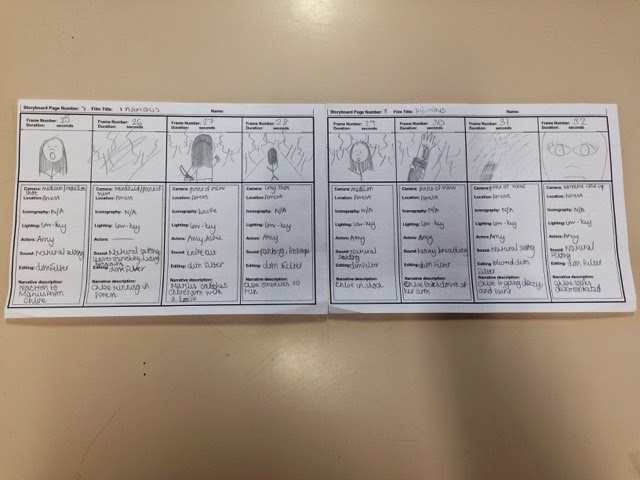
The purpose of a group storyboard it that it shows the development of our individual storyboards and the final decision made. We looked at each of our individual storyboards and decided what we liked from each one and what parts we were to take and insert into the final group storyboard. Storyboards that demonstrated a better idea of what we wanted to portray were very much inspiration for our final group storyboard.

We have created a group storyboard to ensure that we have a final idea and decision for what we are doing. This makes it easier for us when filming as we have a clear structure of what needs to be shot and in chronological order too. We took many of our individual ideas and put them into our group storyboard as well as developing group ideas too.  Different elements have been taken from each of our storyboards. Not only from our own individual storyboards, but we have also taken inspiration from other thriller films too. The use of low-key lighting for example was inspired by 'Strangers' and 'Shutter Island' as we really liked the way it helped create a tense and eerie atmosphere. You can clearly see in our storyboard, we have noted our lighting as low-key throughout most of it and this is because these parts are the ones where we want suspense to be created and elements of shock also.

The use of a dim filter was a also a developed idea from the way we all wanted to have low-key lighting and having a dim filter ensures this. This creates enigma and we all agreed on this idea that the dim filter would very much help determine the atmosphere of the scene to more of what we intended. We found this element restricts view creating more suspense, surprise and shock making it more conventional to the thriller genre. This is why we thought it would be appropriate to use throughout our sequence. As well as this, filming was made easier to complete as it didn't matter as much to depend on natural lighting for our shots as a filter would correct the lighting to exactly how we would want it to be. A dim filter is used in most thrillers for example in 'Saw', and so it just contributes to the conventionality of a sequence to the thriller genre, as well as giving the scene a more eerie look. Knowing that using a dim filter was sticking to the thriller genre made us even more confident in including it into our sequence. The storyboard demonstrates our input of this filter and so when it comes to editing, it is clear which shots need the dim filter as we have noted it down.

Point of view shots, for example in frame 7, were included in our group storyboard. This was an idea from me and Danny as we thought it would create more suspense as the audience get to see the scene from the antagonist's perspective however, not actually know the identity of them. Through the use of a point of view shot, especially in the way in which we are using them, the audience are also able to see other characters from a specific character's point of view. This builds a relationship with this character as they may feel worried for them and want to help them. The way suspense, surprise and shock are created also makes it conventional to the thriller genre. We made sure to note these down in our group storyboard to ensure that we knew what we were filming as point of view shots can sometimes be difficult to draw. Having them written in our group storyboard also allows us to not overuse them as the structure is clear and straightforward which allows us to check for accidental repeated shots. In order for point of view shots to be successful, they shouldn't be overused as they become common and do not have as much of an suspenseful impact. Therefore having them noted in our group storyboard allows us to prevent this from occurring, benefitting our sequence when it comes to editing.

A montage in our group storyboard (frame 23) was an idea of Alfie's, but we have also taken inspiration from a clip from 'Saw 4' which uses a montage to emphasise particular images in the shot. This creates suspense and tension from the images being juxtaposed together in a fast tempo movement. Therefore, this has more of an impact on the audience as they have to pay more attention to what's going on on-screen, keeping them gripped and captivated, as well as intrigued. This is conventional to the thriller genre as suspense is created and also a climax for a shocking, surprising moment to occur. In 'Saw 4', the montage uses flashes to separate the various shots that are used as the content. We really liked this effect as we found it was evident that it was a montage, keeping the rest of the scene and narrative clear and understandable. It also gave the montage a supernatural feel as using flashes and fast paced shots together is unnatural but also gripping. This is what we intend to create and so we will do this with our sequence in our montage. It was difficult however, to display the exact shots that we wanted in our montage onto our group storyboard as it was basically the previous shots we had already used. Though, we decided to still ensure we left a frame to make note of the montage's existence to make sure that we didn't forget to include it.

I think our storyboard is organised and structured in an efficient way. We discussed each other's individual storyboard ideas to incorporate every group member's ideas making compromises to ensure that each individual idea is taken into account. As a group, we are happy with our group storyboard as it is clear, understandable and easy to work with. It not only makes filming easy, but also editing as it is clear what needs filters, particular sound and lighting adjustments, etc. We have also made clear the particular shot that will be filmed for each frame and so from doing it so accurately, it allows us to have a rough estimate of how long our sequence will be, if we are reaching the time limit or if we need to film more. Our group storyboard has inspirations from other successful thrillers that already exist, such as the ones already mentioned and so this makes us confident that ours is conventional to the thriller genre. Having a clear group storyboard saves time as messiness would determine level of understandability which would take up more time working out what goes where and how. Overall I think our storyboard is organised, successful and will make our filming easy and not time efficient. 

This is our group storyboard, consisting of 37 frames:


Wednesday, 26 November 2014

Individual Storyboard - Miss Miller

Individual Storyboard

The purpose of a storyboard is to ensure organisation, structure and order. Having a storyboard makes each stage of the film a lot more clearer with knowledge of how each scene progresses to the next. Storyboards are used in film planning so that everyone involved in the making of the film can see clearly what their film is going to be like and how it is going to be set out and what is the content of each frame. Filming time is then extended as, there is no time wasted on trying to organise what needs to be filmed and how from the way a storyboard would have already been previously created.

We have created individual storyboard's before creating a group one to allow each individual the opportunity to express their own ideas. Then, we can incorporate these different ideas together to make sure that every group member's ideas are inputted and a best possible sequence can be make as a result. The combination of all group members' ideas merged together makes the thriller a lot more stronger conventionally, for example, one individual could suggest a good idea the others hadn't thought of, and so can share this idea which can be inputted into the sequence. I hope that my individual post will help when planning my group one as I believe some of my ideas are worthy of sharing likewise with my other group members' ideas. I hope I can serve a good contribution to our final group storyboard combined with my other group members' ideas to create a more successful and effective thriller sequence.

This is my individual storyboard:


My storyboard consists of 36 frames. It shows how a girl is walking home with two friends and they have to go their separate ways (the two friends together and the girl left on her own). The girl finds herself walking through the forest and begins to hear many strange noises - voices to be specific. She continues her journey, however, still is frequently hearing these noises as she carries on. She calls her mum in panic who doesn't pick up and a shot of the girl and a masked man is shown on screen, however, the girl is not aware of his presence. She carries on walking and hears the noise again to turn around to a masked man blocking her path. She runs away and finds him out of sight only to see him once again. This time she runs but he catches her arm with a knife. She carries on running but her knife wound begins to bleed quite heavily and as she notices this, she slows down. The antagonist is no longer in sight and the girl is left staring at her arm. She becomes drowsy and lost at the sights of her wound and faints. The screen then blacks out and this is the end of the sequence. Low-key lighting is an element shown throughout to create this unknowing atmosphere and suspense from the lack of view in which the audience have. This will leave them feeling on edge and tense as they are unable to view the scene as it really is with everything distinctively in sight. There will be extreme close up shots included for example in frames 10 and 25. This allows the audience to relate to the character a lot more as they are able to see their emotions in much more close up detail. Because of the screen covered by the extreme close up of the character, it restricts the view of the rest of the scene and so creates suspicion within the audience. Furthermore, violent iconography is included and introduced in frame 29. Audiences will feel on edge as they will clearly be able to see the use of iconography used, a knife. It is also not revealed until near the end of the sequence, so, there is a whole build up of tension throughout the sequence until finally when the knife is revealed. This creates a climax and more of an impact on the audience making them feel worried for the victim. The audience are expected to be surprised, shocked and feel suspense towards the sequence from the sudden appearance of the antagonist for example. They are expected to feel what a thriller intends to make them feel which is those 3 elements as stated because it is what they expect and want to feel. I have taken inspirations from films for example Se7en. Throughout the opening sequence of Se7en, the antagonist's identity is not revealed and I think this is very effective and is what I have taken into account when creating my storyboard. 

Each of our individual ideas will need to be taken on and this will be done by each reviewing and analysing each other's work, finding which parts in each individual sequence is most effective. I hope that my ideas are taken onboard such as the shot where the antagonist is stood behind the victim - visible to the audience but invisible to the victim. I think this shot is really effective because once the shot changes to another one then back to that same shot the antagonist is then gone, creating suspense from the fact that the audience were able to witness him there and then gone unknowing as to where he has disappeared to. 

Overall, I believe that my storyboard is fairly good. There are elements that work well and elements that don't. For example, the reaction/medium shots work well as their specific positioning compliment the scene well in order to create suspense. However, at the beginning my storyboard shows a slight drag of the shots which was intended to build up tension, however, when actually coming to film could be difficult to do so. The final group storyboard will probably have many more frames than my individual one as. I left part of our narrative out as, I found it was difficult to create a variation in shots for some parts, particularly the beginning. This will be resolved however, by complying all of our ideas together to ensure that lack of variation doesn't occur.

I have found this post helpful with regards to filming our sequence because it has allowed me to express my own individual ideas before discussing with my group. This then allows my ideas as well as my group members' to be taken into account in order to create the most successful thriller possible.